Most Founders Are Just Well-Paid Admins
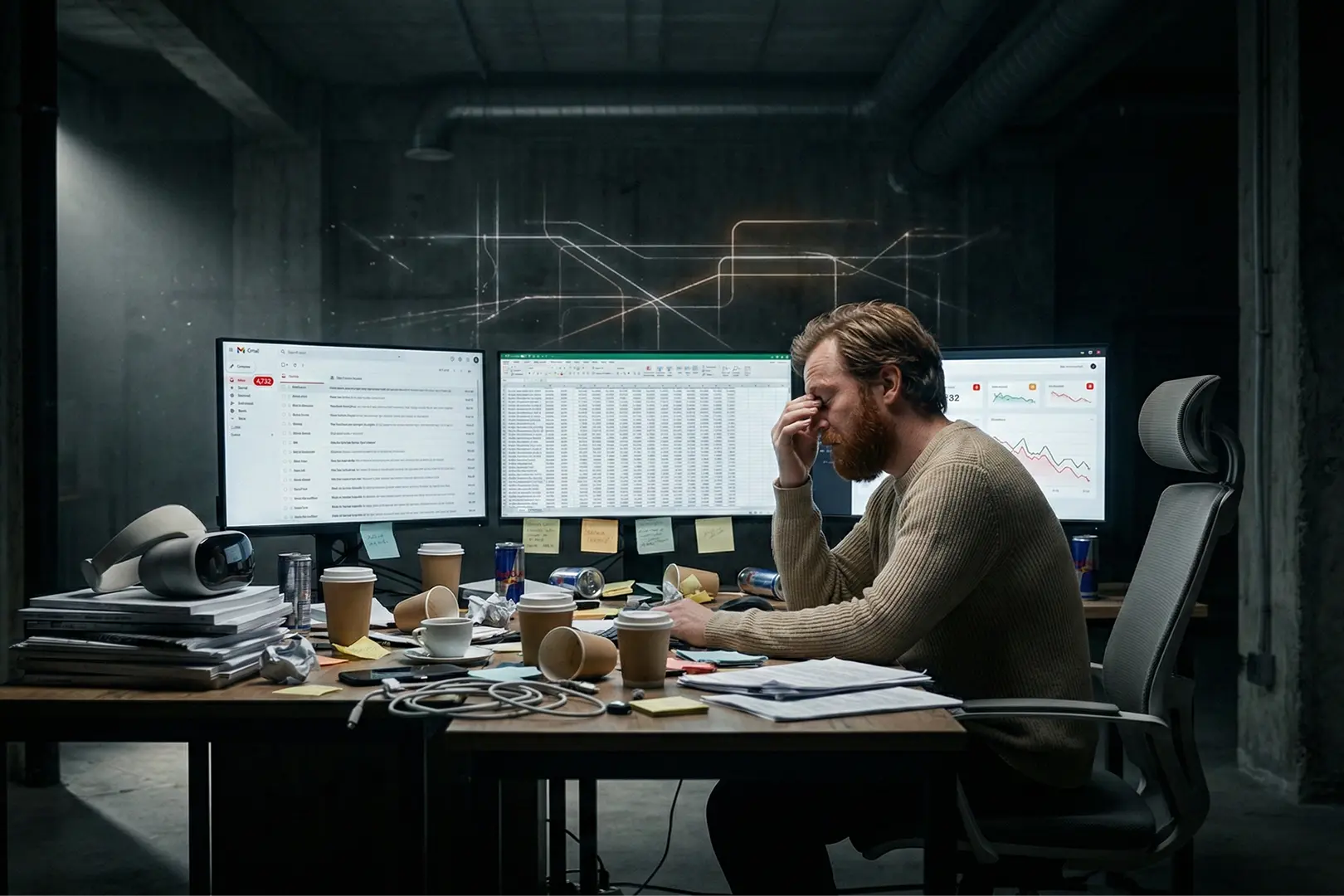
There is an uncomfortable truth that almost nobody in the startup world says out loud. A huge number of founders are not building companies. They are managing inboxes with better branding.
You can call yourself CEO. You can write "building in public." You can talk about growth and scale. But if your day is mostly replying to emails, forwarding information, updating spreadsheets, sending reminders, chasing invoices, and manually moving data between tools, that is not executive work. That is administrative work wearing a nicer title.
The trap is subtle. It does not feel like admin work because it is connected to your business. A new lead comes in and you log it. A client signs and you send the contract. Someone fills out a form and you notify the team. It feels responsible. It feels necessary. It feels like leadership.
But it is still operational drag.
Operational Drag Hides in Small Tasks
Operational drag is dangerous because it hides in small tasks. Five minutes here. Seven minutes there. A quick check. A quick update. A quick message. None of it seems significant on its own. Yet by the end of the day, you have been context switching for hours. You have been reacting instead of designing. You have been maintaining instead of building.
The real cost is not just time. It is cognitive residue. Every time you switch from product thinking to logging a lead, from strategy to Slack, from creative flow to spreadsheet formatting, part of your attention stays behind. Your brain never gets the long, uninterrupted stretch it needs to do meaningful work. You feel busy. You feel drained. But nothing durable was created.
This is how founders quietly become well-paid admins.
Success Often Makes It Worse
The irony is that success often makes it worse. More leads mean more logging. More customers mean more onboarding emails. More revenue means more invoicing, more updates, more coordination. Growth without systems does not free you. It multiplies the manual work. The very thing you worked for becomes the weight that slows you down.
Most founders build externally before they build internally. They obsess over product, marketing, design, positioning. Meanwhile, the inside of the business runs on duct tape. Forms go to inboxes. Inboxes trigger manual tasks. Reports are assembled by hand. Information is copied from one tool to another because "that is just how we do it."
It works at first. Then it compounds in the wrong direction.
Most of the tasks drowning founders have clear inputs and predictable outputs. None of that requires human judgment. It requires wiring.
It Is Not a Personality Problem
Here is the grounded truth. A form submission should trigger a logged lead. A payment should trigger a status update. A signed contract should trigger onboarding steps. None of that requires human judgment. It requires wiring.
The silver lining is that this is not a personality problem. It is not about being disorganized or undisciplined. It is a design problem. If you are manually acting as the bridge between tools, the system is incomplete. You are filling the gaps with your own attention.
The shift happens when you stop asking, "Who should handle this?" and start asking, "Why does this require a person at all?" When you wire your forms directly into your CRM, when invoices update your records automatically, when notifications route themselves to the right place, your day changes. It gets quieter. You stop being the middle layer. You start seeing the business as an engine instead of a checklist.
Stop Being the Glue
A founder should be focused on direction, leverage, decisions that compound. Not formatting spreadsheets. Not forwarding details. Not checking if someone updated a column.
If your company depends on you to manually move information from one place to another, you do not own a scalable system yet. You own a job with extra complexity.
That sounds harsh. It is also empowering.
Because every repetitive task is a signal. Every sigh you let out before copying and pasting is feedback. It is your business telling you that something is poorly designed.
Most founders are not failing because they lack ideas. They are exhausted because they never removed themselves from the machinery.
You do not need to work harder.
You need fewer manual bridges.
Stop being the glue. Start being the architect.